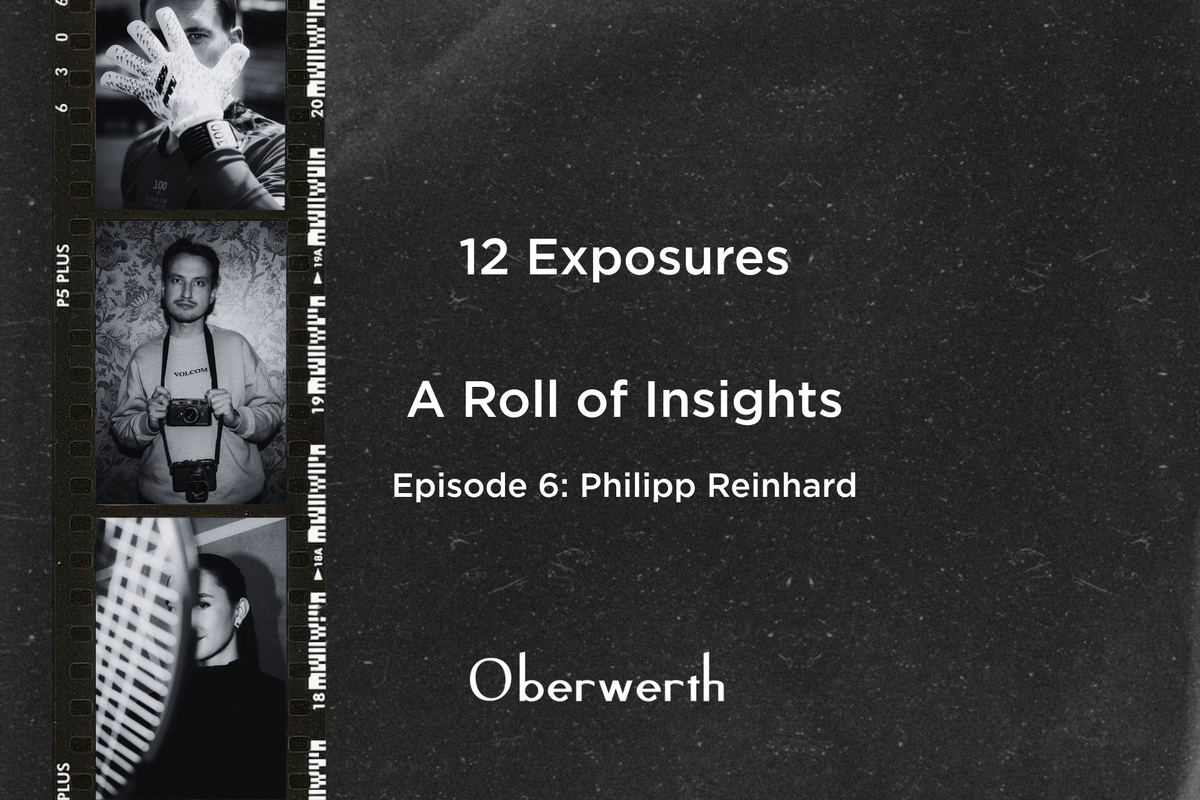
12 Exposures - Episode 6: Philipp Reinhard
Philipp Reinhard is a sports and street photographer who works, among other things, as the DFB team photographer, at the Olympics, and for international brands. Together with Oberwerth, he developed the Simple Strap. In this interview, he explains how a decades-long hobby turned into a career, why analog photography still fascinates him today—and what makes a good camera strap.
1. When you look back on your journey in photography today: Was there a specific moment when you realized that photography meant more to you than just documentation? Or was it more of an ongoing process?
In my case, I got my first analog camera when I was 14—and analog photography has been a constant part of my life ever since, for over 20 years now. What started as something I “just happened to have with me” turned into something I “always have with me.” I never would have believed that I could one day make a living from photography. Until about a year to a year and a half before I went into business for myself, it was purely a hobby for me—I didn’t even own a digital camera. Actually, I’d always wanted to go into film: cinematography, and maybe eventually directing and concept development. I was even a little intimidated by photography because I’d never really learned it properly. There are so many things you have to know—using a flash, image editing—that I had no clue about back then. I’m a trained media designer; I knew how to put images together and create compositions that work visually and in terms of layout. But the thought of a major production made me nervous. So in the end, it was a gradual process that kept growing—and suddenly, there it was.
2. You enjoy shooting with film. Is that compatible with sports photography, where there’s so much movement—how do you decide when to take the shot?
For me, digital photography is really always a medium for commissioned work—I shoot digitally when it’s for a job, partly because the images often have to be delivered almost immediately. Analog photography, on the other hand, has always been the reward for my hard work. That little spark that used to drive me: I drop off my film, get it back, feel excited, and don’t know what’s on it. It’s still like that today. That’s why I also take analog photos at the Olympics or for the DFB. I feel like analog photos have a special quality when you look at them. And because I never mention that I’m taking them at all, nobody asks about them—so I never feel any extra pressure and can just enjoy the whole process. That’s actually why I came up with the Simple Strap. I always had my main camera, the Leica Q3, on a long strap, and I wanted to carry an analog camera as well. But it’s hard to run around with too many cameras if the straps aren’t well-coordinated. Now the straps are spaced far enough apart that the cameras don’t bump into each other. This way, I can simply sling the M6 over my shoulder, quickly lift it up, take an analog photo, set it down again, and still continue working digitally in my normal workflow without any interruptions.

3. Since we're on the subject of the Simple Strap: Why is “I take photos” the statement you chose?
Because that's just the way it is. I just take pictures—nothing more, nothing less. Some people always make a big deal out of it and say they’re making art. I don’t want to take that away from anyone—after all, art is always in the eye of the beholder—so maybe I’m making art, too. But in the end, I think it’s nice when photography stays simple. That’s why I chose a simple, beautifully crafted strap. And “I take photos” was the most essential thing it could be boiled down to. For me, that doesn’t require a flowery quote with a meta-level meaning. When I pick up the camera, it’s very simple: I take photos.
4. Aside from simplicity, what else was important to you? What were your requirements for the strap?
I didn’t want to develop a strap that would just be pushed onto the market, bearing only my name and “Oberwerth”—and that would be the end of it. I’ve always found product design incredibly interesting; if things hadn’t worked out with photography, I might have ended up doing something along those lines at some point. In that sense, this was a project I was very excited about. It was never about making money for me, but about bringing an idea to life. High quality and experience were much more important to me. My hope was to find a partner in Oberwerth who could make a strap with a quality similar to that of a Leica—one you can rely on, that holds up in all situations, and that’s allowed to age. The strap doesn’t have to look brand-new in two years; it’s allowed to develop a patina. For me, the main criterion was that this strap could withstand that. At the same time, I wanted a Simple Strap that solved one, two, or three more problems than a regular leather strap. For example, I always found it annoying when the strap slipped off my shoulder when worn across the body—there was never anything really good to prevent that. That’s why the Simple Strap features this red, textured Alcantara-like material, which solves exactly that problem. And sometimes the days are long, and the strap starts to pinch at the back of your neck—a Leica weighs quite a bit because of its materials, and carrying two doesn’t make it any lighter. The small padded section makes it noticeably more comfortable. We’ve also fine-tuned the little details, such as the metal ring that attaches to the camera: It’s designed so that it doesn’t come into direct contact with the camera’s metal and cause scratches. So we’ve tried to create a strap with very few changes that solves a few more problems than a standard camera strap, which is defined solely by its lengthand material.

5. What inspired or influenced you in the design process?
I’m someone who finds tactile things incredibly beautiful—which is probably why I like Leica so much. When I touch something I use often, I want it to feel good. That’s why the type of leather we use was so important to me: it needed to have a certain weight and a marbled pattern that you can see and feel, giving you that sense of genuine high quality. The next step was figuring out how much we could trim down the strap—around the edges, the seams, and everything else—so that it would still hold up naturally, but with as few predetermined breaking points as possible.
6. Would you say that good equipment affects not only your comfort but also the way you take photos?
Yes, I’m actually very sure of that. Here’s a simple example: If I were a carpenter, I’d want the best hammer I could imagine—or the best tool, if I’m going to use it every day. As soon as something becomes more than just a hobby and I use it every day, I don’t want to deal with little annoyances that get on my nerves every time: the strap getting tangled, coming loose, or slipping off my shoulder. I want to look forward to using it every time. That’s how it was with the Leica in the beginning—and it still is today. Even an M6 is simply something special when I pick it up. And that’s exactly how it should be with the strap: I look at it; it looks really good with the red underneath, those little design touches, the “I take photos” – these are the things that make me think: I’m glad this process is finally coming to an end. When I pick up the strap, I just really enjoy taking photos with it. I don’t have to force myself or remind myself to take the camera with me—I want to have it with me, so I always take it along.
7. You're really focused on sports. Why?
I’ve always said: If I go into business for myself, I want to do something that fulfills me and that I’m truly passionate about. I’m convinced that things turn out better when you truly believe in them. That’s why I used to turn down every wedding, every baptism, every birthday—basically anything I could have made money from—even back when I wasn’t making any money at all. I wanted to stay true to myself, without sounding arrogant. For me, it was a hobby, and when it became clear over the last year and a half or two that it was turning into a career, I told myself: If I’m going to do this, then I want to make money doing things I love. And I’ve been interested in sports my whole life. As a little boy, I’d sit on my dad’s lap at 2 p.m. on Sundays, and we’d watch Formula 1 with Michael Schumacher. Later, I played soccer, then basketball; from age twelve on, I was at the skate park every day, and then I took up surfing. Physical activity has always been important to me—the emotions that sports evoke, the sense of well-being, physical coordination, being part of a group, and dealing with defeat. So if I stay true to my values, there’s really only this sports sector where I should be working. And when you’re very active yourself, you also think a bit like an athlete. That creates parallels and common ground: When I’m in the locker room with the basketball players and we’re talking about basketball, it certainly helps that I’ve always played myself. In a ballet setting or working with animals, I’d have a much harder time talking authentically with people about the issues that matter to them.
8. What kind of sports are you currently doing?
My sports portfolio is always a little bit of whatever’s available and where no one’s telling me what to do. I’m currently trying to get back into skateboarding—back to my roots—and see how it goes. Other than that, it’s a lot of soccer, basketball, and tennis. Those are the things that are mainly keeping me busy right now.

9. Is there a motif or theme that appeals to you right now, but that doesn't yet connect you to anyone else? Or are you sticking with sports?
Sports is, so to speak, just my professional identity. I originally came from a very traditional background in street photography —I photographed scenes on the street, casually, in the moment, anticipating certain situations. I believe that’s still the DNA of my sports photography today: it carries that street photography within it and doesn’t come across as polished; it doesn’t look much like classic sports photography. Behind it all lies the common thread—people, emotions, and stories. What’s behind a person? To this day, that’s the most important thing to me, and it’s what interests me about others as well: the story behind the person. When I meet someone for a photo essay—a mechanical engineer or a bodywork technician—I’m incredibly interested in their story for as long as I’m with them—regardless of whether it has anything to do with sports. If you break it down even further than just sports, it always comes down to the person in the end.
10. Is that also how you prepare for a photo shoot? What role does preparation play, and how much do you leave to chance?
My photography always thrives on chance. I deliberately leave room for it—I don’t plan every minute down to the last detail—so that something can actually emerge during the shoot. When things go well, there’s a bit of magic: it clicks, the subject opens up, and you get shots you hadn’t planned at all. In that moment, you need the freedom to go down that path a little further with the person—those are the moments you wouldn’t otherwise get. Still, I always prepare professionally and don’t just walk in unprepared to do everything freestyle. In the end, it’s a fifty-fifty thing. I thrive on improvisation; that’s always been my greatest strength: improvising, anticipating, responding to situations as they arise, and processing them quickly. But of course, I need to know where the light is coming from and where a good angle is. When I’m working with Roger Federer for Mercedes in San Francisco at noon, I need to know in advance what’s about to happen—the schedule is so tightly packed that everything has to run smoothly and there can’t be any downtime. And I also know that I’m good at filling in those gaps.

11. If you could give some advice to young photographers interested in sports and physical activity: What’s easy to learn, and what might you need to unlearn if you’re coming from a different field?
First of all, there’s nothing you actually have to “unlearn”—at most, you can try to adapt certain things. And that’s the beauty of it: Because everyone sees things differently and perceives details differently, it’s all the more rewarding to develop your own style. There’s only one way to do that: do it, do it, do it—and keep taking pictures over and over again. In the end, it’s a bit like sports, like training. If I don’t take many photos for two years, I won’t be as prepared to handle a stressful situation as I would be if I were constantly at it. Still, you shouldn’t compare yourself too much to others or place too much importance on likes and comments. That would be my advice. I believe that good work always prevails and gets noticed—not with the first or second photo, but if you stick with it and persevere a little, something can come of it.
12. To wrap up: Let's say you show ten images that truly represent your style—what do all these images have in common?
I believe they all tell a story and convey an emotion. And they all have certain layers: there’s rarely an image that’s completely flat. I always try to work with different layers and give the image depth—a certain three-dimensionality. Those are probably the three things: there’s always a story in it, it’s always about an emotion, and you can find different layers in the image.