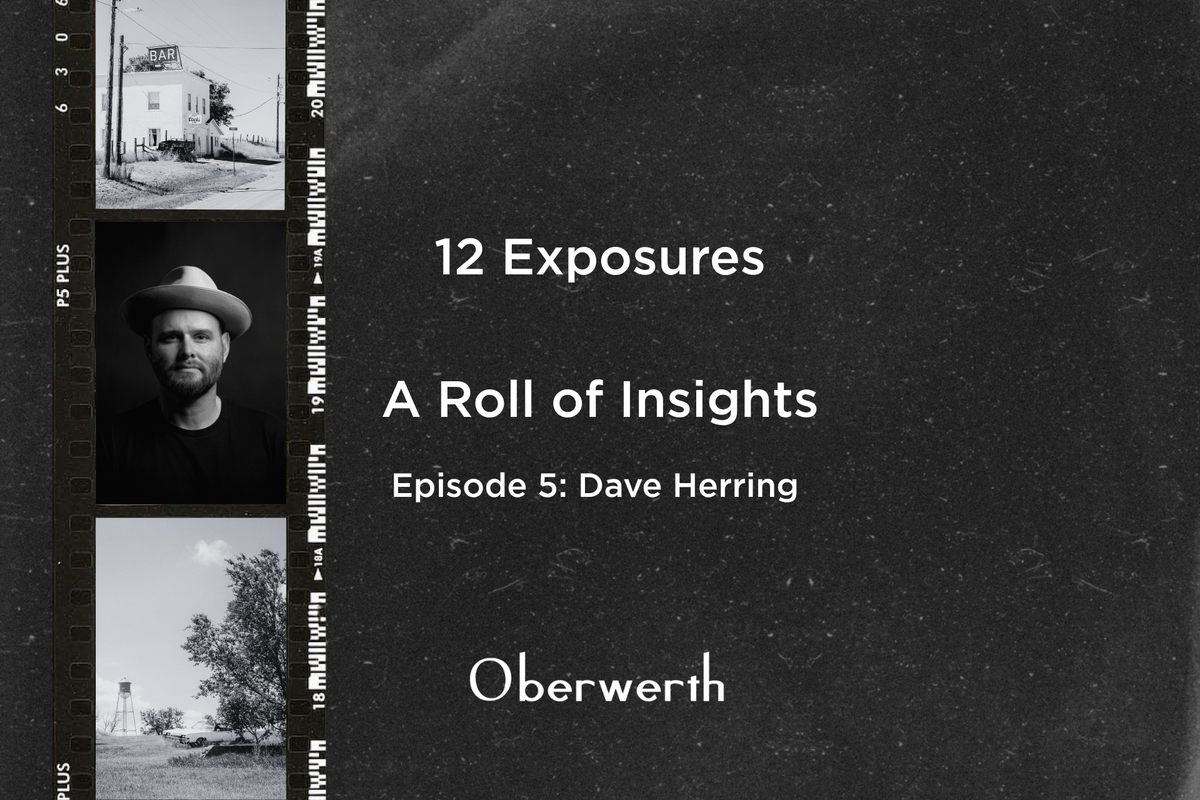
12 Exposures Episode 5: Dave Herring
Dave Herring - Photographer, filmmaker, author and creative director from the Bay Area, California.
With a deep passion for the rugged beauty of the American West, Dave creates striking visual stories in both analog and digital formats, often working with Leica and Hasselblad cameras. His work combines adventure, lifestyle, editorial and commercial photography with a keen sense of atmosphere, detail and authenticity. In addition to his work for nationally recognized brands, Dave shares his creative philosophy, tutorials and insights via his YouTube channel. He is also the founder of Very Good Presets, where he develops sophisticated color corrections for photographers. Driven by curiosity, craftsmanship and a love of storytelling, Dave brings a thoughtful and very personal perspective to everything he creates.

1. why is it important to you to share your creative process and your philosophy with your community instead of just showing finished work?
Accessibility is really important in art. As people gain experience and learn new things, it benefits art when knowledge is shared, especially in a field like photography where there are so many people with cameras, from ordinary people with a smartphone to people who have invested tens of thousands of dollars in equipment. Whether it's information, ways of thinking or just accessibility: By making these things accessible, you enable more people to be creative. When that happens, everyone benefits.
2. what inspired you to document small towns in America's Northern Plains and what do you hope to preserve through your photography?
Many cities in the Northern Plains are at the end of their life cycle. We live in a time when an era is coming to an end. Most of the time, we don't realize something is over until we look back and say, "That town stopped being a town in 1955. "I think our generation is seeing some of these towns disappear. In a few years, some of them simply won't have people living in them anymore. That makes it a worthwhile task to document them. In the United States, we don't have as much historical depth as we do in parts of Europe. So what still exists of our history is very significant. The Northern Plains has a rich history, but the population is small and shrinking. It's a part of America that people often overlook - we even call it "flyover country." People fly over it, but very few actually visit. That makes it important to document. If you're traveling through remote regions for days on end like Dave Herring, you need a bag that combines robust protection with an unobtrusive design. The William camera bag offers ample space for camera, film and travel essentials - designed for photographers who capture stories on the move.

3. how have your experiences traveling through these cities influenced your interest in photographing them?
I used to be on tour as a musician and spent a lot of time traveling through these areas. They always fascinated me. Many of my early photos were taken out of sheer amazement at seeing places with extremely small populations. One of my fondest memories is a town sign with the words "population 3". Things like that always drew me back there. I found it incredibly fascinating.
4. how do you build trust and capture authenticity when photographing very small communities?
The first time I visited a town of three was about 17 years ago. I drove in, got out of my car, and a man who was mowing his lawn came over immediately, because no one ever visits his town. He introduced himself and gave me a tour of the whole place. It was fascinating. Two years ago I returned to photograph the place. Nothing had changed, except that the population was now one. The man I had met before had passed away. A resident had moved into an assisted living facility, and the only person left was the man's brother. I spent time with him and photographed the city again. I asked him if I could photograph him too. One day, perhaps no one would live in the town anymore and he would be remembered as the last inhabitant.

5. how does loneliness affect your creativity when you work in remote locations?
Years ago, I heard a quote that has stayed with me: "Two things influence the heart very strongly - beauty and adversity. Human life is full of adversity. Every generation faces its own struggles, conflicts and challenges. That's why it's important to fill the heart with beauty. For me, that happens when I drive across the Northern Plains or spend time in quiet places in nature. Sometimes I go on photo trips where I don't talk to anyone for several days. There is no cell phone reception, no connection. This can be draining, but these places also replenish my heart and soul. Reliable equipment is particularly important on long journeys through quiet landscapes. The Oberwerth Sling Bag sits close to the body, remains pleasantly light and allows quick access to the camera, ideal for spontaneous moments on the move.
6 When do your best ideas come to you - when you work alone or with others?
It depends on the project. When I'm working on something that involves other people, collaboration can lead to the best ideas. Community fosters strong creative thinking. But some projects are very personal. Not many people want to travel to a city where only one person lives. In these situations, the best ideas come to me when I'm alone and thinking. This solitude allows me to concentrate fully on the essentials without any distractions.
7. how does your mindset change when switching between personal projects and commercial photography?
Commercial photography sounds glamorous, but in reality it often simply means making sure clients are happy. For several years I photographed for a veterinary company, constantly producing images for them. Did I love photographing doctors treating cats or flying a drone over the building? Not particularly. But I loved doing good work and making the client happy. Commercial work often enables the personal projects that you really care about. Sometimes one art form supports the other financially or through the experience gained.
8. how would you describe your photographic style and how do you maintain it across different projects?
Over time, I have learned to articulate the characteristics of my style. One of the key elements is color minimalism. In most of my photos, there are no more than three dominant colors, often earth tones. This approach runs through everything I photograph - landscapes, editorial work or documentary projects. Because the underlying style remains consistent, the images seem connected, even if the subjects change, and a clear photographic style deserves equally well thought-out accessories. The Oberwerth Louis combines understated elegance with functional organization, perfect for photographers who value aesthetics and precision.
9. what do you think about color correction and the balance between realism and artistic interpretation?
The color correction comes after the photographer's work. Every photographer moves somewhere between realism and fantasy. If you want realism, you don't add turquoise skies or unrealistic color tones. But many photographers enjoy creating a world that looks a little better than reality. That has always been part of photography. Analog photography, for example, has always had its own style that didn't quite match reality. And yet people loved it. In many ways, color correction simply means choosing the kind of visual world you want to create.
10. what role does analog photography play in your work compared to digital photography?
Digital photography is objectively better in many technical respects. It offers a greater dynamic range, more flexibility and control. But film is more fun as an experience. If you miss a shot on film, it's gone. You can't touch it up later. The anticipation and delayed gratification make the process exciting. I like shooting on film for the experience, but the finished photos should still work whether they were shot on film or digitally. If you switch between analog and digital photography, you need flexible companions for both worlds. The Oberwerth George protects sensitive cameras in style and accompanies creative projects with timeless craftsmanship.
11. how has becoming a father influenced your creativity and your work as a photographer?
My wife and I are both artists. She is a tattoo artist, and this shared understanding creates a very supportive environment at home. I take my family on as many adventures as possible. In 2020, for example, we went on a seven-week road trip through several national parks and even took the school with us on the trip. Thanks to this flexibility, I don't feel any conflict between family life and photography. I spend a lot of time at home editing images, and when I'm traveling, I try to take them with me whenever possible.

12. what advice would you give to aspiring photographers who feel overwhelmed by trends and social media?
Build meaningful relationships locally rather than seeking validation online. The opinions that matter most to me come from friends I actually spend time with - photographers I walk, travel and discuss work with. Feedback from strangers on social media doesn't have the same value. Growth comes from having trusted people who can give honest feedback. This is how photographers evolve from good to great. Also, be honest with yourself. Some days you'll come home empty-handed, and that's okay. Practice consistently, learn from the experience and try again the next day.