What Kind of Camera Is the Leica M3? A must-know for Leica fans!
What is the Leica M3?
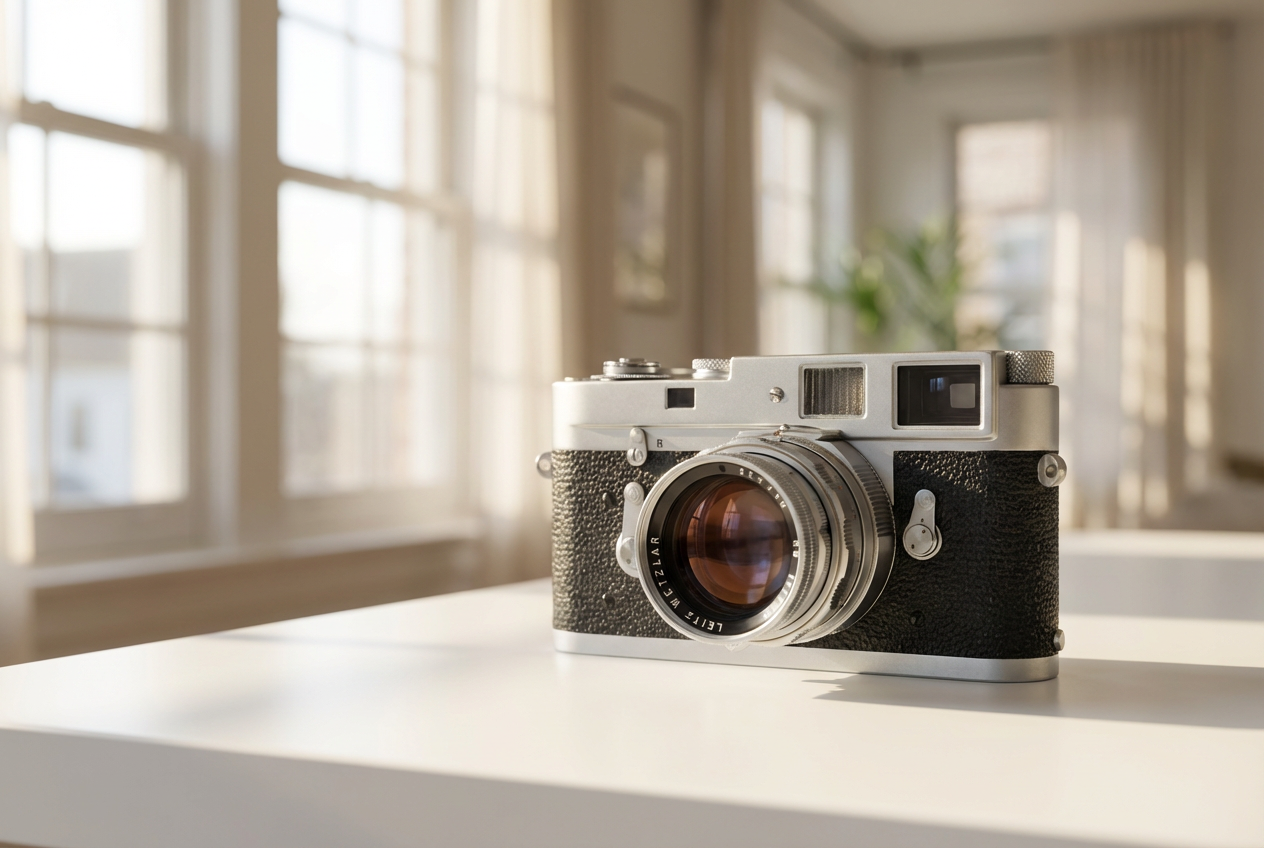
The Leica M3, launched in 1954, was the first model in Leica's M series. It represented a significant advancement over the earlier compact rangefinder cameras of the "Barnack" type and is often referred to as the ultimate rangefinder camera. With the introduction of the M3, Leica's design philosophy and user ergonomics matured considerably and laid the foundation for all subsequent M-series cameras.
At that time, SLR cameras were not yet widely available, and rangefinder cameras were a special category that required both precise focusing and portability. With this in mind, the M3 was praised for allowing users to perform the entire photographic process - loading the film, composing a shot and releasing the shutter - with remarkable ease.
Historical significance as the first Leica of the M series
The M3 was more than just a new model, it symbolized a generational change at Leica. The Barnack-type models were compact and easy to transport, but their controls and the clarity of the viewfinder had their limitations. The M3 solved these problems by enlarging the body and introducing innovations such as higher viewfinder magnification and automatic bright field switching, greatly improving both usability and the shooting experience.
Even today, the M3 is often referred to as "the origin of Leica" and enjoys great popularity on the second-hand market, earning it the nickname "Queen" among collectors. Fully mechanical, battery-free and equipped with a brass body and precise mechanisms, it continues to fascinate camera enthusiasts more than half a century after its market launch.
Design and ease of use: the charm of brass and mechanics
One of the most attractive features of the M3 is its design and handling. Its solid brass body combines durability with a sense of luxury, and its weight conveys the "joy of ownership". The layout of the controls has been significantly redesigned, including the film advance lever, shutter speed dial and film advance mechanism, all of which have been optimized for intuitive operation.
As the M3 is completely mechanical, it does not require batteries. All functions - shutter release, film advance and frame counter - are mechanically controlled, providing a tactile security and rhythmic shooting experience that modern digital cameras cannot offer. This precise mechanical feel is a key reason why the M3 has been so popular for decades.

Key specifications and innovative mechanisms
The M3 is also characterized by its ingenious internal mechanisms. Its cloth focal plane shutter supports speeds of up to 1/1000 of a second, covering everything from fast movements to long exposures. Previous models had separate settings for high and low speeds, but the M3 combined these into a single dial that allows intuitive, uninterrupted shutter speed adjustment.
The viewfinder offers approximately 0.91x magnification - one of the highest in the M series - and is designed for a standard 50mm lens. The bright frames automatically switch between 50 mm, 90 mm and 135 mm, and automatic parallax correction ensures precise image alignment. Even lenses with large apertures can be precisely focused, underlining the precision that is characteristic of Leica.
Handling is improved by a one-handed film advance lever and an automatically resetting frame counter. Film loading and preparation is smooth and efficient, allowing continuous shooting without interrupting the rhythm. These groundbreaking innovations laid the foundation for the modern ergonomics of rangefinder cameras.
Why Leica fans love the M3
The exceptional viewfinder accuracy of the M3 is an important reason for its enduring popularity. The high 0.91x magnification and the sharp double image enable unparalleled focusing accuracy, even with fast lenses, and significantly expand the photographic possibilities.
The camera's intuitive functions - one-handed film transport, automatically resetting frame counter and film loading via the rear panel - were revolutionary in the 1950s. The bright frames changed automatically for 50mm, 90mm and 135mm lenses, with automatic parallax correction ensuring accurate image composition. Together, these innovations made the M3 more than just a camera - it became a device that allows photographers to experience the pure joy of photography.
The shooting experience: quiet, refined and precise
Shooting with the M3 is uniquely satisfying. Because viewfinder cameras have no moving mirror, there is minimal vibration when the shutter is released, resulting in a quiet and elegant shutter sound. This subtlety allows photographers to shoot on the street or in quiet interiors without disturbing the scene.
The high magnification viewfinder ensures convenient focusing with lenses from 50 mm to 135 mm. Even wide aperture lenses can be precisely focused, supporting everything from street photography to portraits. An external viewfinder is required for wide-angle lenses such as 28mm or 35mm, offering users the enjoyable challenge of creative composition.
Ultimately, the M3 gives photographers the experience of "precisely capturing what you see". Each press of the shutter button provides both mechanical satisfaction and photographic joy, the essence of the rangefinder experience.

Strengths and weaknesses
Although the M3 is highly regarded, it is important for users to know its advantages and limitations.
Strengths:
- High-precision viewfinder: 0.91x magnification ensures sharp focusing, even with fast lenses.
- Durability and tactile operation: The brass housing and mechanical precision ensure stable long-term use.
- Advanced operability for the time: Simple film transport, automatically resetting frame counter and film transport via the rear panel.
Weaknesses:
- Limitations with wide-angle lenses: Bright frames not visible at 28 mm or 35 mm; external viewfinder required.
- Slow flash synchronization speed: About 1/50 sec., limiting for flash photography.
- No built-in light meter: Exposure requires manual estimation or an external light meter.
- Need for serviced equipment: Due to the age of the camera, properly refurbished cameras are recommended.
By understanding these points, one can fully enjoy the precision and handling of the M3 and experience the joy of handling a mechanical instrument.
The role of the M3 in Leica's history
The M3 was not just another camera, it marked a turning point in Leica's history. As the first model in the M series, it symbolized a generational shift from the Barnack cameras and set the design philosophy and ergonomics for later models such as the M2, M4 and M6.
Its high magnification viewfinder, automatic switching to the bright frame and parallax correction set the standard for all subsequent M-series cameras. Many enthusiasts say: "Leica was complete with the M3", although later models were mostly just refinements. Even today, it still enjoys the highest reputation on the second-hand market and remains an indispensable "original camera" for Leica fans. The market launch of the M3 was not just a technical advance, but a historic moment that shaped Leica's philosophy and the enduring appeal of the rangefinder.

Why the M3 is still a good choice today
Although it was launched in 1954, the M3 is still very valuable today. Its appeal goes beyond its historical significance - its handling and shooting experience are still comparable to or even surpass modern cameras.
The precise mechanics and high magnification viewfinder provide the tactile satisfaction and accurate focusing that are unique to film photography. Completely mechanical and battery-free, it is durable and reliable. The feel of loading and transporting the film provides a unique sense of "the joy of shooting" that cannot be achieved with digital cameras.
With proper maintenance, the M3 remains fully functional and can be adapted to modern shooting styles. For film enthusiasts or fans of Leica history, owning an M3 is an authentic way to experience the origins of Leica. Mastering the M3 also teaches the finer points of film photography - wide-angle use, exposure control and more - making it more than just a tool, but a camera you can truly enjoy shooting with.