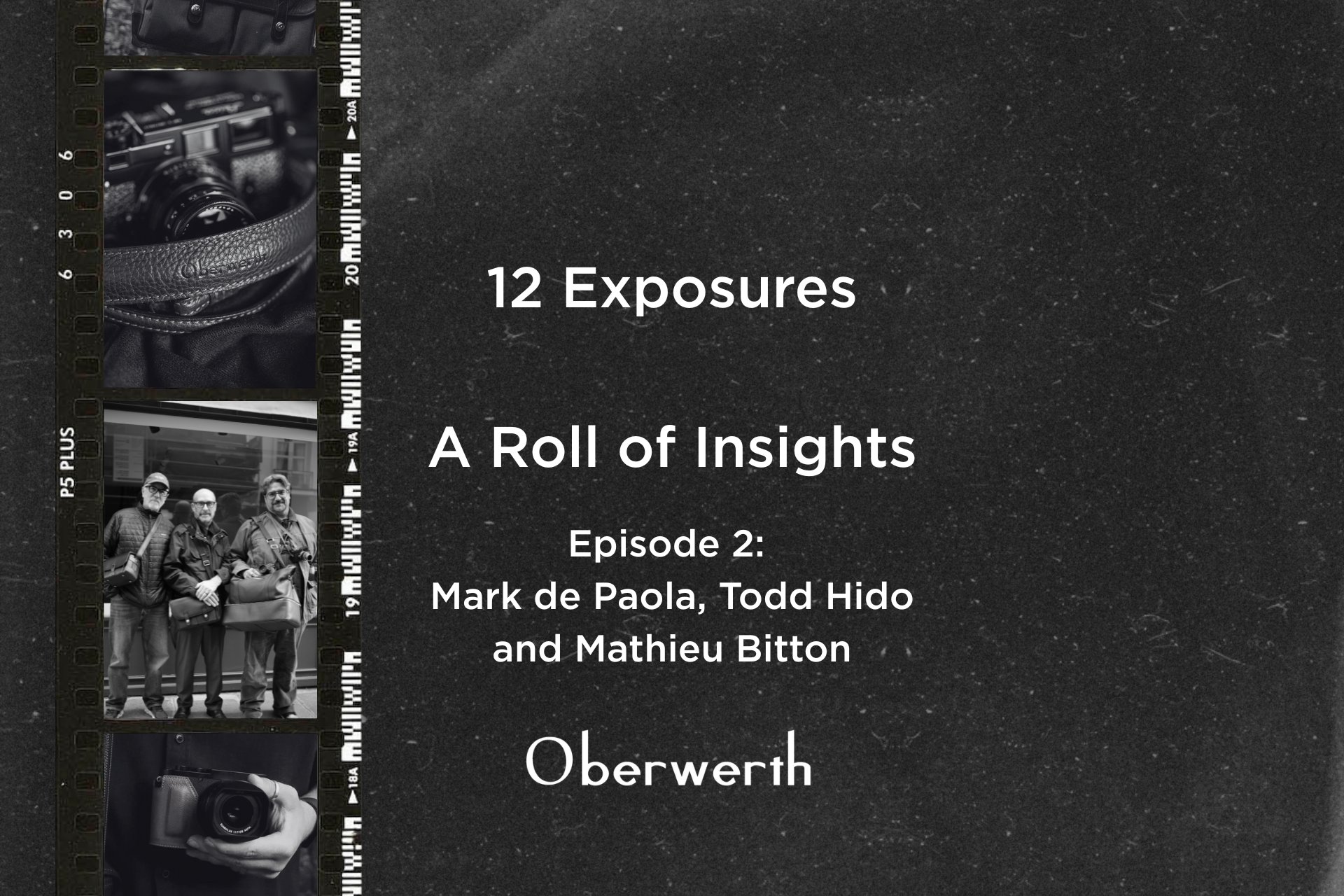
12 Exposures - Volume 2: Mark de Paola, Todd Hido and Mathieu Bitton
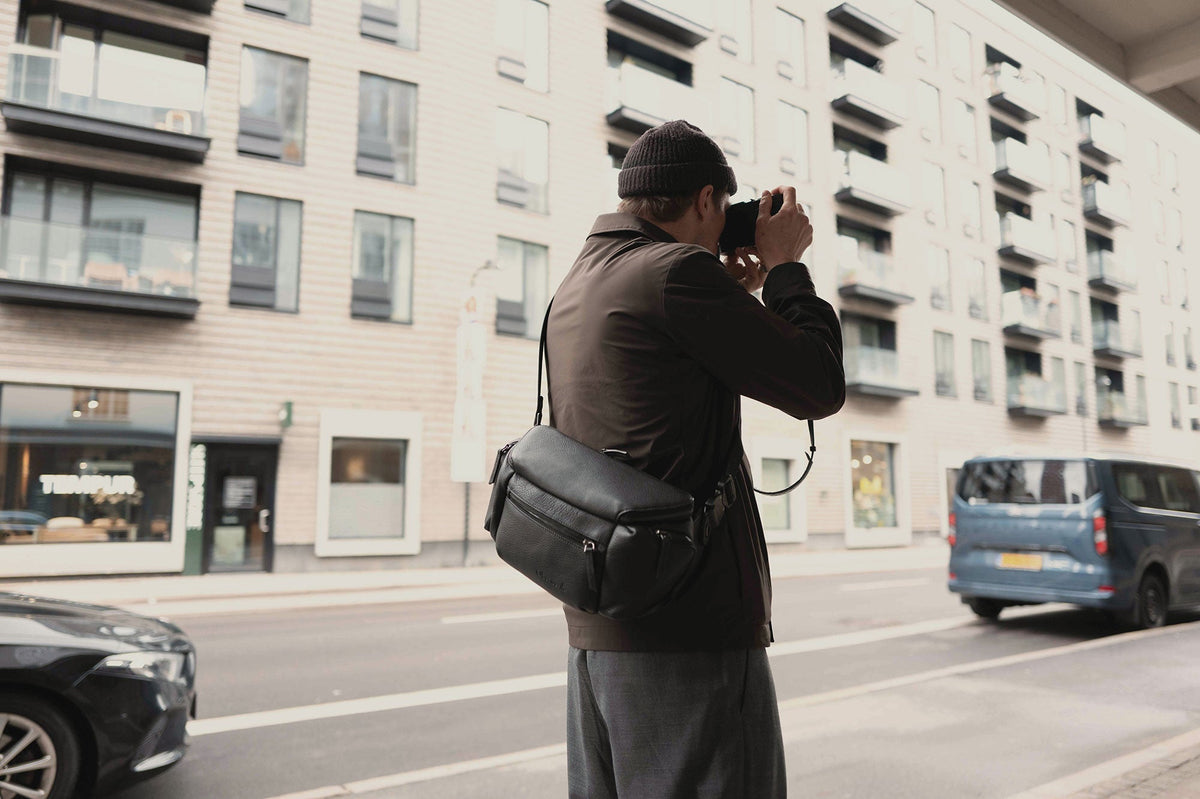
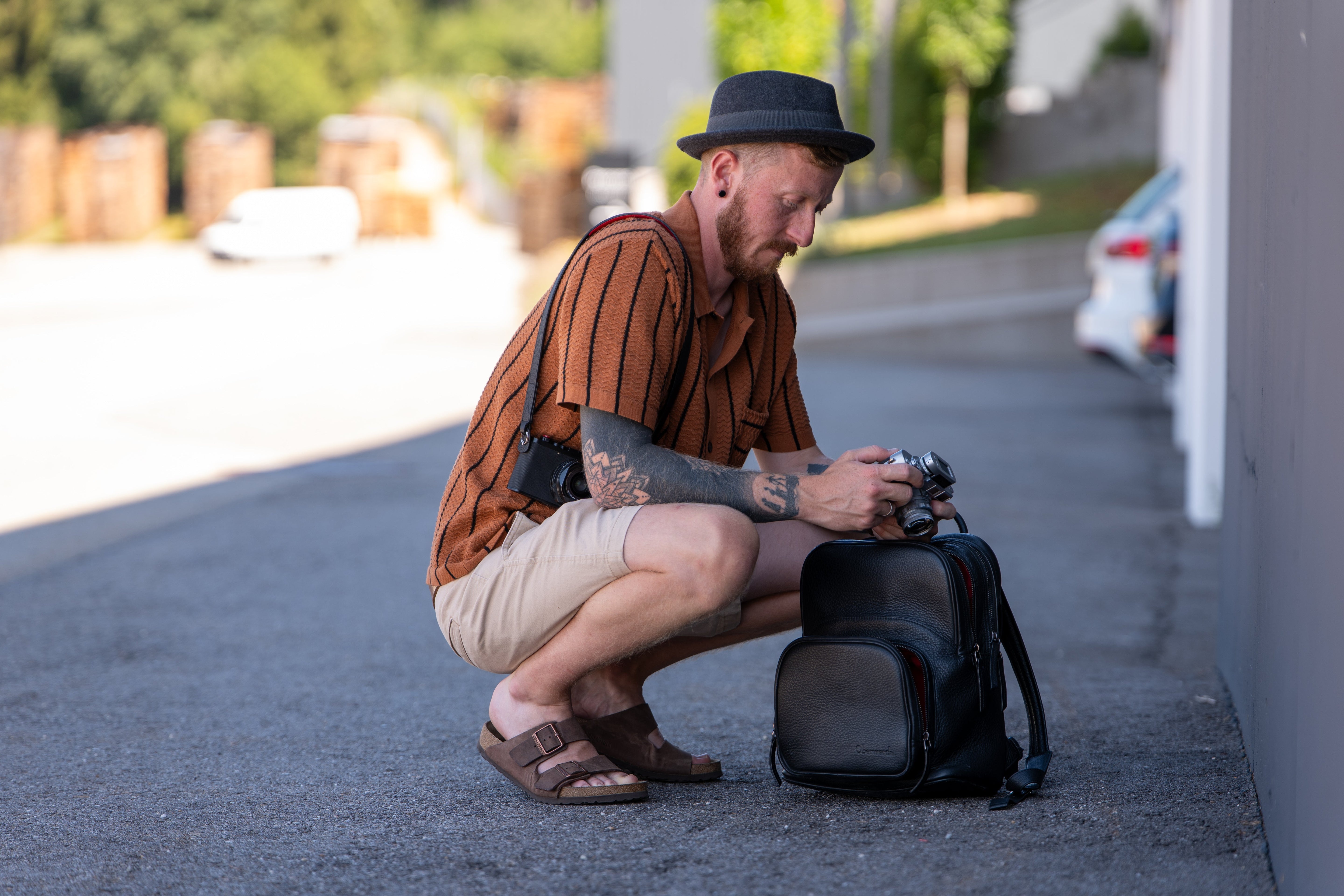
Three photographers, three styles, and a shared moment in Paris. On November 5, we met with Mark de Paola, Todd Hido, and Mathieu Bitton for a personal conversation about beginnings, turning points, and the quiet decisions behind great images. Between cafés and studios, they accompanied us with the very bags that shape their everyday work: Mathieu with the Weekender Nelson L, Todd with the Messenger Bag Little William, and Mark with the Signature Bag M. An interview about photography as an attitude, about intuition instead of perfection, and about what remains when technology fades into the background.

You each came to photography in different ways. How did you begin, and what made you pursue it professionally?
Mark de Paola:
My story starts very early. My father was a photographer, so I grew up around cameras. As a boy in New York I’d go to Central Park to photograph youth culture with a Nikon and a 200mm lens my stepfather brought back from Japan. I felt like a “professional” until one day I was held up at gunpoint in the park and they took my camera bag.
Suddenly I had no camera, and that’s when I realized how deeply photography was part of my identity, even at 12 years old. I scraped together money and bought a Leica M3 with a collapsible Summicron. That changed everything. With a 50mm you can’t hide; you’re in the middle of the scene. The young hippie girls would pat me on the head and say, “Photo boy, take my picture.” For a 12-year-old, that was pretty powerful. That’s really where my life with Leica and with photography as an active participant began.
Todd Hido:
I got into photography through BMX racing in the 1980s. Back then, you couldn’t just film your friends with a phone, you had to learn how to take pictures. So I photographed my friends jumping ramps and doing tricks. That hooked me.
I’ve never done anything else as a career. I started working around 15 or 16 with a Nikon, and I’ve essentially been a photographer ever since.
I switched to Leica much later, around 2020. My friend Jason Momoa, who’s obsessed with Leica and collecting cameras, was making a film about my work. He introduced me to Leica by literally giving me one. The quality was unbelievable, and I never really looked back.
Mathieu Bitton:
I’m a late bloomer as a photographer. I grew up in Paris and spent every Sunday at the flea markets with my father, who collected paintings and mid-century furniture. I was always drawn to the photography in those galleries - especially when someone had Avedon prints on the wall.
Professionally, I started out as an art director and designer in music. Photography was something I did on the side - photographing girlfriends, musician friends, doing album covers because I “had a camera.”
My problem was that my friends were real photographers, people like Jean-Baptiste Mondino, and I didn’t want to say I did what they did. I told myself, I’m the design guy; photography is just for fun. And a lot of my freinds made sure to tell me I should stay in my lane. The design lane.
Eventually record label executives started noticing that the photos on the albums I designed were also mine: “Wait, you shot this and designed the cover? Why don’t you do both for us?” That’s when I had to accept that I was, in fact, a photographer. That shift really happened around 2001–2002, so it’s been about twenty years.
If I have to choose today, I’d say I’m a photographer first, everything else wraps around that.
Every photographer develops a personal style or voice. How would you describe your photographic vision, and how has it evolved?
Mark de Paola:
If I had to choose one word, it would be natural. My images aren’t heavily burdened by technique or what’s considered “proper.” I prefer a looser approach that feels alive and accurate.
Throughout my career, people have hired me precisely because my work doesn’t look overproduced or staged. They want something that feels authentic and unforced. That’s the through-line from my early work to now.
Todd Hido:
My work has always had a strong sense of atmosphere and mood. I can make very sharp, straightforward pictures of architecture and houses, and I enjoy that. But when I’m in the landscape, I’m often drawn to “in-between” conditions—fog, rain, bad weather. Those environments have become a signature of my work.
Night is especially important for me. Night has many colors; you can push it warm, cool, green, artificial. It gives you a huge palette. My “cinematic” style of night photography evolved naturally as I explored those possibilities.
Ironically, I learned photography in a very technical way first: 8×10 view cameras, studio lighting, strobes, all geared toward being a commercial photographer. Later I went to an art school—the School of the Museum of Fine Arts in Boston—where they taught you how to see, build bodies of work, make books. So I learned technique first, and then art. I still don’t do things “by the book”—I do them the way I want them to look.

Copyright: Todd Hido
Mathieu Bitton:
For me, the greatest compliment is when someone sees a picture in a magazine or on Instagram and says, “I knew that was yours.” That recognizability is what I value.
I’d describe my work as accentuated reality. I’m not heavy on Photoshop; I’m trying to capture someone’s essence, especially with musicians or public figures. Celebrities are photographed constantly and often don’t enjoy it, but when they see themselves in my pictures and say, “That’s actually me,” that means everything.
Sometimes I’ll be on a big campaign with a full crew, and I’m just there in the background making a few frames. Later the artist or label wants to use my image because it feels true, even if we have to fight over usage or budget.
So my style is about high-contrast reality and authenticity. It’s what’s there, pushed slightly into my own world.
When you plan or create a photograph, which elements, light, subject, location, movement, are most important to you?
Mark de Paola:
Like Todd, I was trained very technically. I learned on an 8×10 camera, so I’m comfortable with natural or artificial light and all the mechanics.
What I’m known for, though, is being able to make something out of anything - to arrive in any situation and quickly see where the magic is. It’s not one specific element; it’s the sensitivity to recognize a sliver of light, a reflection, a color cast, and then use it.
I once did a Gucci shoot here in Paris. We were in a hotel, waiting for a model while hair and makeup worked. I went to the bathroom and noticed the red walls and a small sconce casting red light. When the model was ready, everyone expected to start in the street, but I said, “Let’s begin in the bathroom.” The team had flown in from Seoul and probably thought I was crazy—but those pictures became key images.
So my priority is seeing any light and using it to create something unique and beautiful, even in places most people would dismiss.
Todd Hido:
The best place to photograph is wherever the light is.
I’ve made portraits on the landing of the stairs in my house because there’s a stained glass window there that creates incredible light. The pictures look like they were made in a studio or a painting studio, but it’s just a strange spot on a staircase.
For me, the light has to be right. On a bright sunny day with blue skies, I often don’t even bother shooting outside. I prefer dusk, overcast, rain, or snow—conditions with nuance and atmosphere. I’m not a “sunny f/16” photographer.
So yes, subject and location matter, but if the light isn’t interesting, I usually just don’t take the picture.
Mathieu Bitton:
A lot of what I do is driven by the moment rather than elaborate setups. I'm always on the road, touring with artists, shooting backstage, on stage, on the street, or really anywhere, so I'm constantly chasing whatever is happening in real time.
That said, I’ve recently discovered how powerful it can be to create a controlled space close to home. For the first time, I did several shoots in my backyard in Malibu. The light came through the trees in a beautiful pattern, and I realized, This is a perfect little outdoor studio.
So we set up a backdrop and some lights, and suddenly great actors and musicians were coming out to Malibu. We’d shoot in the yard, then maybe walk down to the beach in three minutes.
What all three of us share is that our photographs aren’t overly complicated. They can be simple in setup, but behind that simplicity are decades of hard work and practice. That’s the part people often underestimate.

Copyright: Mathieu Bitton
From your early work to now, was there a turning point or challenge that defined your trajectory as an artist?
Mark de Paola:
There were a few big turning points.
One came when I was studying law at USC and decided I didn’t want to be a lawyer. I went to a film magazine to place a tiny ad: “Mark de Paola Photography” with my phone number.
A woman in an office kept staring at me. Finally she called me over and asked, “Are you good?” I said, “I’m… good.” She repeated, “No - are you really good?” I doubled down: “Yes, I’m really good.”
She said, “I need a cover photo of Henry Fonda.” That became my first assignment: photographing one of the most iconic actors in American cinema for a magazine cover—without anyone having seen a single picture of mine.
Very quickly I found myself in the world of celebrities. Shortly after, I shot another extremely famous person, and at 24 I was offered a Vogue Mexico cover. I honestly thought it was a prank call. Those experiences set the stage for my work in film, fashion, and beauty that continues today.
Todd Hido:
Two big shifts stand out.
One was when I started photographing at night. That’s when my work really found its narrative, cinematic quality. My first book, House Hunting, came out in 2001, but those pictures were started years earlier, around 1995–96, when I moved to California for graduate school.
The second turning point was photographing through the windshield of a car. My first attempt was actually an accident during a snowy winter in Ohio. Snow slid down over my windshield as I stopped to shoot. I took the picture anyway. Only later did I realize how much I liked this idea of photographing through something—creating a more painterly, atmospheric image.
And studying with Larry Sultan was crucial. He was my mentor and helped shape my understanding of home, family, and narrative in my work.

Copyright: Todd Hido
Mathieu Bitton:
My big turning point was a very difficult year around 2007. I was held at gunpoint, ended up in the hospital, our house was burglarized, and almost all my equipment and hard drives were stolen. A lot of my pre-2007 work is simply gone.
At that time I was doing design, photography, artist management, video, and trying to launch a merch business. I went to see my friend and mentor Jeff Ayeroff, the legendary label executive. I told him, “I feel like I’m on the Titanic.”
He looked at me and said, “On your Titanic, you’ll figure out how not to sink.” That one sentence flipped a switch.
Around the same period I was spending time with Quincy Jones, who became another mentor. I’d come to him with a hundred projects—managing artists, designing, directing, shooting. One night he stopped me and said, “Where are you actually making money? You’re doing too many things.”
He told me to focus on the two that could be a real career. Listening to Quincy Jones say that to you at dinner in his house is… clarifying. I realized I needed to drop management and other side paths and commit to photography and design.
Not long after, I reconnected with Lenny Kravitz and ended up on the road with him for the better part of a decade. That decision—to narrow my focus—was the most important pivot in my career.
For someone starting photography today, beyond the technical basics, what habits or mindsets would you recommend?
Mark de Paola:
Don’t become obsessed with focus and sharpness. There’s a huge marketing push around “the sharpest lens” or “more megapixels,” but neurobiologically, our emotions live in the out-of-focus areas of our vision—and of our photographs.
If everything is clinically sharp, it often becomes less emotional. Todd’s work is a great example, as is mine: we embrace out-of-focus elements as part of the narrative.
So: don’t blindly follow marketing or other people’s rules. Find your own way of seeing, even if that means breaking supposed technical “perfection.”

Copyright: Mark de Paola
Todd Hido:
Experiment, but not forever.
At the beginning, it’s important to try different approaches so you can discover what resonates. But once you find something that works, stick with it for a while. Don’t constantly change your camera, lenses, film, or style.
Some of the greatest photographers—Winogrand, for example—used one camera, one lens, one film stock for years. When I shot film full-time, I used one camera, one film, one paper. That consistency let me really understand what I was doing and push it further.
So: find what you’re interested in, put a stake in the ground, and stay with it long enough to go deep.
Mathieu Bitton:
I love a quote from Prince that I use in my presentations: “It’s not the notes that make something funky, it’s what’s in between the notes.”
Photography is similar. What matters isn’t just what’s in perfect focus or what the manual says is correct—it’s what’s in between, the things that break the rules.
Most of the true geniuses I know in music left school because they were being told what not to do—“you can’t put that note with that note”—and they needed to explore their own language. The same applies in photography.
The goal isn’t to become “the next Todd Hido” or “the next Mark de Paola.” If your portfolio looks exactly like someone else’s, even if they’re great, you’ve skipped the most important part: developing your own identity.
Learn from others, absorb influences, but use them to find your own voice—not to imitate someone else’s.
When you look at your own body of work, what do you think sets you apart from other photographers? – could you describe it in one sentence?
Mark de Paola:
I think that the following words could apply to many artists and creatives, a sort of ingredient list to what I find are common denominators: individually, intent, experience, and tenacity. I feel that my work resonates because I provide a space of honesty and non judgement so that my collaborations with others have the power to celebrate a human truth. My technical process also contributes to this because I do no post production or editing whatsoever to my images.
Todd Hido:
The cinematic approach I use to photograph different subjects utilizing various approaches to multiple genres, like nighttime images, landscapes, and portraiture.
Mathieu Bitton:
There is a hyper-realistic fantasy feeling I believe I have brought to my images are a result of a very rare access I have been granted to many people who would not normally be that comfortable in front of the camera in private moments.

Copyright: Mathieu Bitton
Do you experience a tension or a challenge to your artistic freedom when pursuing photography professionally?
Mark de Paola:
I am hired for my art and because of the work that I do. I don’t pursue a way to adapt my art to be accepted or changed to fit a commercial agenda. I do it my way and that individuality is reflected in all oft he work I do, whether a commercial, a fashion campaign, or an exhibition. It’s important to me that it all reflects who I am as an artist.

Copyright: Mark de Paola
Todd Hido:
Not at all - I enjoy working professionally, because I like to spend time collaborating with other people.
I’ve done several fashion campaigns and editorials, but I have to say one of the most productive ones was when I borrowed clothing from a favorite designer for six months and utilized it in my artwork over that period of time. I was able to make things that really worked for me, but also able to provide the fashion house with 10x the images made from the usual 2 or 3-day shoot..
Mathieu: Bitton:
I think the tension I have felt is only my own feeling of not being worthy of extraordinary luck I have to be in so many incredible places with so many of my heroes.
How has your equipment changed over time?
Mark de Paola:
When I first started, the industry was obsessed, much as it is now, with sharpness and perceived perfection in the image. Since the beginning I have progressively pursued ways to deconstruct an image or narrative further to create something more emotional, so as to further involve the viewer. Emotion is contained in the out of focus areas.
Todd Hido:
I’ve gotten to be more simple. I have less equipment, but I want to be able to take that equipment to most places I go.
Mathieu Bitton:
Everything is like a reverse Scrabble sand timer for me. I worked my way to working with my dream cameras and lenses, which I have become an avid collector of. I used to “have to” shoot with whatever I could afford until my work allowed me to shoot with what I wanted.
Photography often involves unexpected moments , surprises , or failures. Could you share a story of a project (or photograph) that didn’t go as plaanned and what you learned from it?
Mark de Paola:
I was directing a commercial when an Academy-Award winning actress in Los Angeles, and the day began with such difficulty because it was the first setup, we were forty takes in, and we weren’t getting the performance I knew that we could get from her. Still, with patience after each take, I knelt beside her with guidance until finally we got it. For the rest of the day everything moved like butter.
At the end of the day she shared with me that she was actually testing me in order to see if I would lose my patience. „I too need to know that I am safe.“ It was an important reminder for me that I carry with me every days that safety, comfort, and, grace are critical aspects to powerful creative collaboration in my work.
Todd Hido:
My first attempt at shooting through a blurry windshield was a complete accident. At the time I mainly focused on photographing suburban houses at night, but I would drive around scouting during the day, looking for promising houses or neighborhoods.
It was a snowy winter in Ohio, and as I stopped to take a picture of the street, the snow that had built up on the top of my car slid down the front windshield. I took the photo anyway, because it seemed interesting, but I didn’t really understand how much I liked that new direction until much later.
Mathieu Bitton:
I recently was hired to fly to London and shoot one of my favorite artists, Raye. I had photographed her during an impromptu performance in LA early this year and she loved the photos so much she decided to have me shoot her new single “Where Is My Husband!” The shoot went phenomenally and we had a great time, but the main cover image was sabotaged by the prop master who made a giant heart that she and two of her musicians were supposed to carry across a busy street.
The heart was too heavy therefore I wasn’t able to get the shot I had imagined. So her creative director said they were gonna go in a different direction. This felt like a personal failure but luckily they used some of the photos for press and Raye’s big NFL halftime performance in the UK. The single ended up coming out using the original concept but using a BTS photo shot in between my shots. There’s a first time for everything! And I hope it’s the last time.

If you could give one piece of technical advice to an amateur photographer who aspires to develop their craft, what would it be?
Mark de Paola:
Don’t let the technicality of the craft hinder the more important development of your artistic vision as an artist. That being said, know your equipment inside out, test daily, and shoot everything manually. The camera doesn’t know what you want the image to be, only you do.
Todd Hido:
In the beginning, definitely try out different things as you’re learning so you understand different technical methods and results of making pictures. It may feel unconnected, but it’s a really quick way to find out what works for you. Then once you arrive at something that works, stick with it for a while. Work through the challenges that present themselves with that approach, instead of getting frustrated and switching to another style.
It’s perhaps not technical advice, but I also think that taking photography workshops can be an amazing way to learn a lot in a short amount of time. Only part of that learning comes from the instructor - the main thing is to be around other creative people and be inspired to consider different approaches and feel the energy of being around other photographers.
Mathieu Bitton:
Learn to manually focus. Even if you have an autofocus camera. You will become so much better at the craft. I believe in the Cartier-Bresson way of shooting, especially for street photography.
As your work has matured, how do you keep your passion, curiosity or creative stimulus alive - how do you re-reset or refresh your vision when you feel you might be repeating yourself?
Mark de Paola:
I don’t have any difficulty with keeping my passion for photography and cinema alive. I’m obsessive about the work that I am priviliged to do each day – to give light to a truth, to tell stories, and to be in a constant self excavation and exploration as I evolve as an artist.
Todd Hido:
I’ve often used different methods for making pictures and I will often work on multiple projects - when I’m hitting a wall in one area, I can go on to another and work on that project, sometimes they merge, but at least it keeps me moving.
Mathieu Bitton:
I Have honestly never been more inspired and excited about photography as I am now. I am always shooting, on days off, at lunch, dinner, walking around… even in the supermarket tonight! I go pretty hard for long periods of time so the reset lies in the days off, still with a camera in my hand. I am fortunate enough to live in Malibu where I can do beach walks, mountain walks and watch sunrises and sunsets for inspiration and motivation. That is my therapy.
Looking ahead, what project or exploration are you most excited about (that the readers haven’t yet seen) , and what do you hope it will allow you to express or discover?
Mark de Paola:
Having grown up with my mom who was a powerful and strong woman, film producer, and model, she installed in me the importance of telling authentic women’s stories. I’ve just completed my first feature film ‚A Stab at Heaven‘, and I am now developing two additional feature film projects and finding ways for the fine art stills and cinema to coalesce with one another, and expand a kind of philosophy and world that is dePaola pictures that is near and dear to me.
Todd Hido:
I recently was in Tokyo, and it was very curious to walk around in the suburban areas and see commonalities in what I look for in my night work in the United States. I’m interested in photographing other homes in other places to explore the cultural differences and more importantly, the similarities, in the ways that we live.
Mathieu Bitton:
I am working on a new body of work currently titled “Rapture in Blue.” As of now it’s a nature photography project shot between Malibu and Ohio. I am using old 1930s-1970s lenses. Some close up water studies that look like they are shot in space. I am also thinking about doing a Music book, which people have been asking me to do for years. and of course, I am starting to think of ideas for a Dave Chappelle book. Or two. I am also working on a show at the Soho Grand hotel’s beautiful new gallery in Soho, NYC.